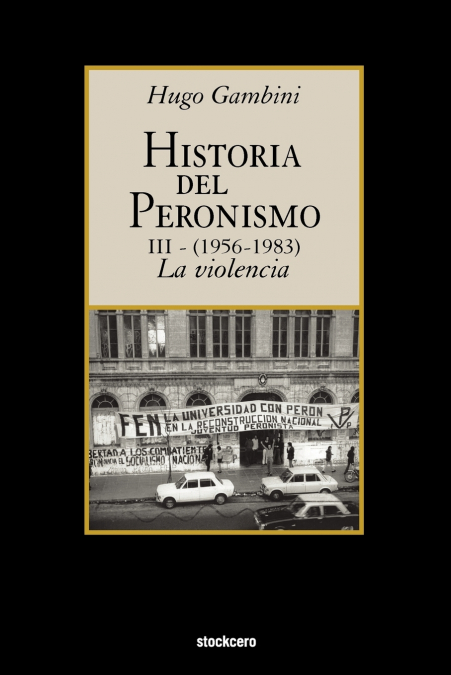
Sinopsis Historia del peronismo III (1956-1983)-la violencia
This third volume of the History of Peronism, by Hugo Gambini, completes the history of one of the most popular and long lasting Latin American political movements and unravels the enigma about general Peron and his followers ideological stance.After the 1955 coup the CGT, Confederacion General del Trabajo de Argentina (Argentine Labor Confederation), strived to keep its power, obtained by being the pillar of the 'organized society', as conceived in 1946 by Peron under the intellectual influx of Mussolini. At this point the struggle was limited: those who attempted a 'peronism without Peron', and the 'verticalists' who felt safer by blindly obeying the leader, rather than acting as interpreters of an ideology that even they found elusive.However, entering the ?60s, a complicated, though fertile, environment surrounded the movement as it attempted the destabilization of the also difficult to define Argentine military governments. The cold war deployed in Latin America created a crisis in the peronism linearity, as it confronted the opportunity of taking advantage of the energy raised by the Castro-Che Guevara tandem among a generation that knew the peronism-antiperonism antagonism only through their parents? remembrances. However this move entailed the peril of blurring its own rightwing mass movement essence, and jumping into a melting pot with a leftist group, closely related to communism, which Peron always had considered the major enemy in his struggle for society organization and control.«History of Peronism - III (1956-1983) The violence» deals with this period, and follows general Peron?s path showing how this Latin American military man, with an early XX Century right wing nationalistic upbringing, achieved -in a most unlikely syncretism- to have the Argentine right wing national fascism and Castro-communism joining efforts after the goal, finally reached, of bringing him back into power after 17 years of absence.Peron?s quick physical decay, and his death in 1974, uncovered the unbalance between the different factions of his followers -and, by the way, also among those who had the duty to repress legally his successors? factions violent attempts to seize power- unleashing one of the most violent periods in a country that, until then, had considered itself as an exemplary republic of peace and tolerance.The casualty count raised exponentially: after the 1955 coup general Aramburu had ordered 31 executions, comprising military and civilians. On returning to power General Peron ordered the shooting of 64 young leftists. His wife raised the count to 900, and the military to 9,000. The guerrillas acknowledged the killing of 745 people, both military and civilians.
EAN
9781934768198
Editorial
Año de edición
2008
Páginas
484
Idioma
Castellano
Colección
.
Alto
2290
Ancho
1520
38.99 €
- 5 % DTO
37.04 €
En stock
IMPRESIÓN BAJO DEMANDA