https://www.imosver.com/ca/libros/times-arrow-the-origins-of-thermodynamic-behavior-00107037070010703707Time?s Arrow: The Origins of Thermodynamic Behavior49.39The Second Law of Thermodynamics has been called the most important law of nature: It is the law that gives a direction to processes that is not inherent in the laws of motion, that says the state of https://static.imosver.com/imagenes_small/9780387/978038794093.jpgLibrosSin stockSPRINGER000https://static.imosver.com/imagenes_small/9780387/978038794093.jpg001067971251.9952.61993/09/179780387940939MACKEY, MICHAEL C.Librosaño_1993idioma_AnglèsIautor_MACKEY, MICHAEL C.saga_Springer Study Edition
Aquest tipus de galetes permeten a l'usuari la navegació a través d'una pàgina web, plataforma o aplicació i la utilització de les diferents opcions o serveis que hi hagi.
imosver_session
Descripció
imosver_session_descripción
Duració
120 minuts
Dependències
Domini
imosver.com
OCT8NE
Descripció
Aquesta galeta s'utilitza per al correcte funcionament del Xat d'Oct8ne per prestar el servei d'atenció al client a l'usuari.
Són aquelles que possibiliten el seguiment i anàlisi del comportament dels usuaris a la nostra pàgina. La informació recollida s'utilitza per a la mesura de l'activitat dels usuaris al lloc web i l'elaboració de perfils de navegació dels usuaris.
_clsk
Descripció
Registra dades estadístiques del comportament del visitant a la web. Això s'utilitza per a anàlisis interns per part de l'operador del lloc web.
Duració
1 dies
Dependències
Domini
imosver.com
logglytrackingsession
Descripció
Identifica i registra la sessió de l'usuari amb finalitats analítiques.
Duració
Sessió
Dependències
Domini
.imosver.com
GOOGLE_ANALYTICS
Descripció
Registra una identificació única que s'utilitza per generar dades estadístiques sobre com utilitza el visitant el lloc web.
Duració
1 any
Dependències
Domini
.imosver.com
_clck
Descripció
_clck_descripción
Duració
1 any
Dependències
Domini
imosver.com
CLID
Descripció
CLID_descripción
Duració
1 any
Dependències
Domini
clarity.ms
_ga
Descripció
_ga_descripción
Duració
2 any
Dependències
Domini
.imosver.com
_ga_LZR660YW0M
Descripció
_ga_LZR660YW0M_descripción
Duració
2 any
Dependències
Domini
.imosver.com
Són aquelles que ens permeten adaptar la navegació a la nostra pàgina web a les seves preferències (per exemple, idioma, navegador utilitzat, etc.).
_fbp
Descripció
Utilitzat per Facebook per oferir una sèrie de productes publicitaris, com ara ofertes en temps real de tercers anunciants.
Sinopsi Time?s Arrow: The Origins of Thermodynamic Behavior
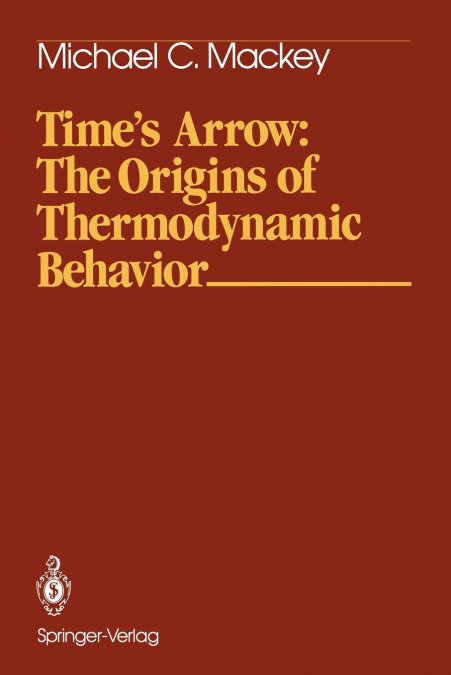
The Second Law of Thermodynamics has been called the most important law of nature: It is the law that gives a direction to processes that is not inherent in the laws of motion, that says the state of the universe is driven to thermal equilibrium. Its mathematical formulation is simple: The entropy of a closed system cannot decrease. Since the recognition that macroscopic phenomena have an atomic basis, it has remained a fundamental problem to reconcile the increase of entropy with the known reversibility of all the laws of microscopic physics. Professor Michael Mackey of McGill University here explores the dynamical basis for the Second Law, that is, he seeks to illuminate the fundamental dynamical properties required for the construction of a successful statistical mechanics. Aimed at physicists and applied mathematicians with an interest in the foundations of statistical mechanics, the book includes such new material as: a demonstration that the black body radiation law can be deduced from maximal entropy principles; a discussion of sufficient conditions for the existence of at least one state of thermodynamic equilibrium; a description of the behavior of entropy in asymptotically periodic systems; a necessary and sufficient condition for the evolution of entropy to a global maximum; and a presen- tation of the three main types of ergodic theorems and their proofs. He also explores the potential role of incomplete knowledge of dynamical variables, measurement imprecision, and the effects of noise in giving rise to entropy increases.