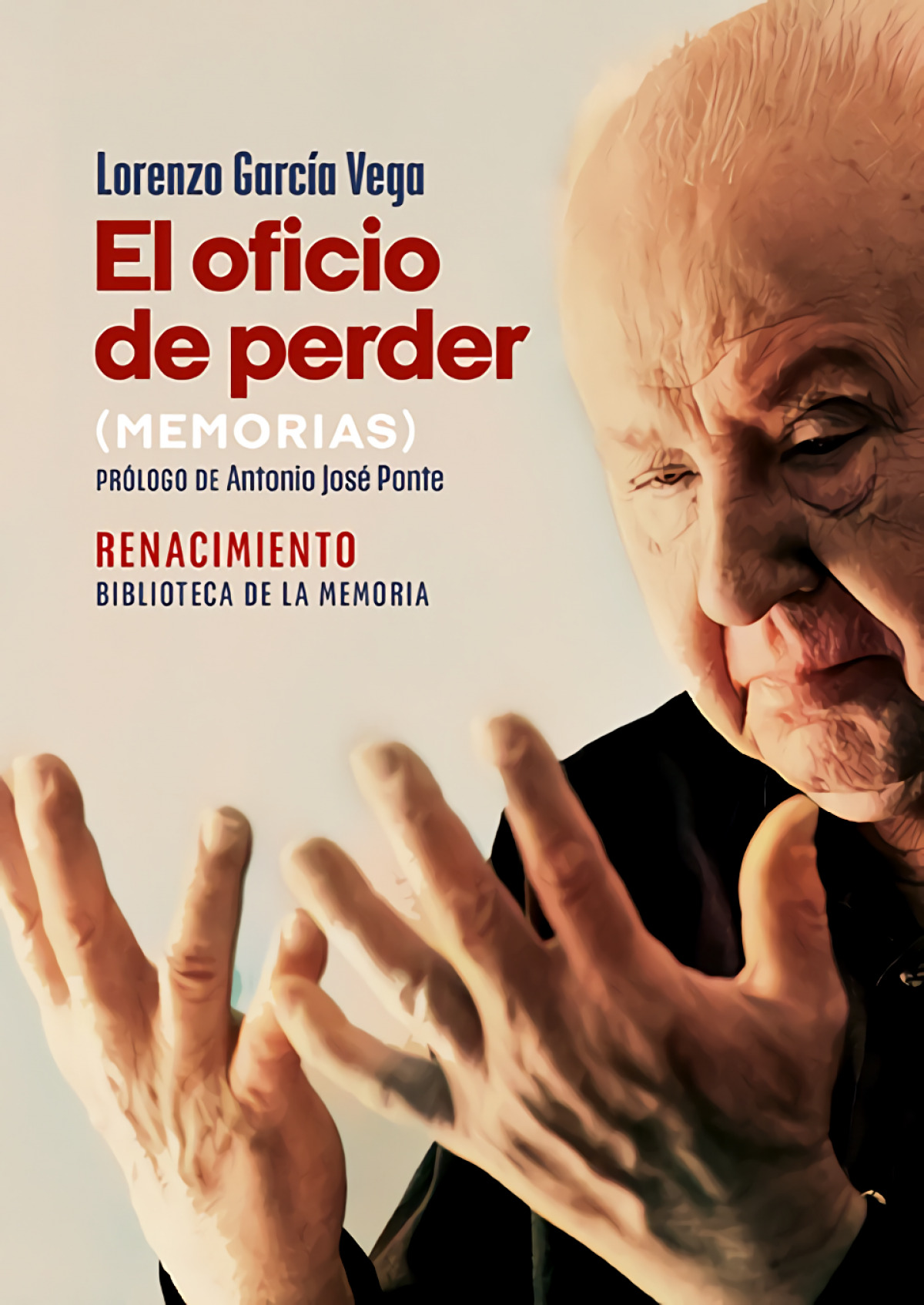
https://www.imosver.com/en/libros/el-oficio-de-perder-memorias-00105299250010529925El oficio de perder. Memorias28.4Este libro El oficio de perder, penúltimo punto del laberinto que se ha ido construyendo García Vega, es una autobiografía que no se parece a una autobiografía. «Pero ¿es posible aún leer un libro asíhttps://static.imosver.com/imagenes_small/9791387/979138755233.jpgLibrosLibros/BIOGRAFIASEn stockRENACIMIENTO EDITORIAL000https://static.imosver.com/imagenes_small/9791387/979138755233.jpg00104845806940040001001000099729.951.52025/02/249791387552336García Vega, LorenzoLibrosaño_2025idioma_SpanishCformato_Tapa blanda o Bolsilloautor_García Vega, Lorenzosaga_Biblioteca de la Memoria
Artículo
El oficio de perder. Memo
García Vega Lorenzo
RENACIMIENTO EDITORIAL
BIOGRAFIAS
Cookie notice
We use cookies to ensure you get the best experience on our site
Read cookie policy.
Manage cookie preferences
This type of cookie allows the user to browse a website, platform, or application and to use the different options or services that exist on it.
imosver_session
Description
Essential first-party cookie. It keeps your session identified while you browse: your basket, your language and access to your account. The website cannot work without it.
Duration
120 minutes
Facilities
Domain
imosver.com
OCT8NE
Description
This cookie is used for the proper functioning of the Oct8ne Chat to provide customer support service to the user.
These are those that enable the tracking and analysis of user behavior on our website. The information collected is used to measure user activity on the website and to create user browsing profiles.
_clsk
Description
Microsoft Clarity first-party cookie. It groups the pages you visit into a single session in order to analyse your journey through the website.
Duration
1 days
Facilities
Domain
imosver.com
logglytrackingsession
Description
Identifies and records the user session for analytical purposes.
Duration
Session
Facilities
Domain
.imosver.com
GOOGLE_ANALYTICS
Description
Records a unique identifier that is used to generate statistical data about how the visitor uses the website.
Duration
1 Year
Facilities
Domain
.imosver.com
_clck
Description
Microsoft Clarity first-party cookie. It stores an anonymous browser identifier so that visits to this website can be attributed to the same user and usage statistics can be produced.
Duration
1 Year
Facilities
Domain
imosver.com
CLID
Description
Microsoft Clarity third-party cookie. It identifies the first time Clarity detects this browser on any website using the service.
Duration
1 Year
Facilities
Domain
clarity.ms
_ga
Description
Google Analytics cookie. It stores an anonymous browser identifier in order to distinguish users and produce website usage statistics.
Duration
2 Year
Facilities
Domain
.imosver.com
_ga_LZR660YW0M
Description
Google Analytics 4 cookie. It keeps the analytics session state so that visits and the journey through the website can be measured.
Duration
2 Year
Facilities
Domain
.imosver.com
These are the ones that allow us to adapt the navigation on our website to your preferences (e.g., language, browser used, etc.).
_fbp
Description
Used by Facebook to offer a series of advertising products, such as real-time bids from third-party advertisers.
Duration
3 Month
Facilities
Domain
.imosver.com
afiliado
Description
First-party affiliate programme cookie. It stores for 30 days the code of the affiliate that brought you to the website, so that the sale can be attributed to them.
Duration
1 Month
Facilities
Domain
imosver.com
MUID
Description
Microsoft third-party cookie. It identifies unique browsers visiting Microsoft sites and is used for advertising, analytics and other operational purposes.
Duration
1 Year
Facilities
Domain
clarity.ms
ANONCHK
Description
Microsoft third-party cookie. It indicates whether the MUID identifier is transferred to ANID, a cookie used for advertising purposes.
Duration
10 minutes
Facilities
Domain
clarity.ms
MR
Description
Microsoft third-party cookie. It indicates whether the MUID identifier must be refreshed.
Duration
7 days
Facilities
Domain
clarity.ms
SM
Description
Microsoft third-party cookie. It synchronises the MUID identifier across Microsoft domains.
Duration
Session
Facilities
Domain
clarity.ms
_fbc
Description
Meta cookie. It stores the identifier of the Facebook or Instagram advert you arrived from, in order to attribute the visit to that advertising campaign.
Duration
3 Month
Facilities
Domain
.imosver.com
_gcl_au
Description
Google Ads cookie. It records a visit coming from an advert so that advertising campaign conversions can be measured.
Duration
3 Month
Facilities
Domain
.imosver.com
_uetsid
Description
Microsoft Advertising cookie. It identifies your browsing session in order to measure conversions from Bing advertising campaigns.
Duration
1 days
Facilities
Domain
.imosver.com
_uetvid
Description
Microsoft Advertising cookie. It identifies your browser across visits in order to measure conversions from Bing advertising campaigns.
Este libro El oficio de perder, penúltimo punto del laberinto que se ha ido construyendo García Vega, es una autobiografía que no se parece a una autobiografía. «Pero ¿es posible aún leer un libro así –pregunta el poeta Carlos A. Aguilera–. Un libro neurótico, ahistórico, sin salida; que dice nada y tampoco quiere decir nada; que no sirve para descansar bajo el sol mientras los niños lanzan piedrecitas a los patos; ¿que no narra ¿Un libro hueco escrito desde ese otro hueco que es la historia y su perverso subebaja ¿Un libro fuera de tiempo y lugar; inútil Parece que sí y parece que con este libro autobiográfico, continuación a distancia de Los años de Orígenes, García Vega se coloca dentro de cierta tradición negativa que tiene entre sus mejores exponentes a Macedonio Fernández, Arlt, Felisberto o Piñera. No sólo porque reescribe desde el delirio todo el tejemaneje cubano: la revolución, el exilio, la república, Lezama, sino porque descompone su núcleo-caricaturesco-de-poder, y traza la mejor radiografía que se ha hecho, en serio “de un país como Cuba. Un país sin memoria y donde hasta ahora casi no han existido memorias. Un país fronterizo”». «El mundo de García Vega –dice el profesor Christophe Singler en su tesis Contra las ficciones, la imagen. El oficio de perder de Lorenzo García Vega– es esencialmente antibarroco, porque la opulencia barroca encubre la escasez, categoría fundamental de su estética. Si juega con lo kitsch, lo hace porque es parte de su circunstancia. García Vega menciona alguna vez su afición a los papagayos de plástico y las estatuillas pseudo-clásicas colocadas en los patios. Para liberarse de la enajenación que representa lo kitsch por simular el sentimiento humano, es necesario pasar por la mímesis de este mundo falso, fabricado por la industria cultural, según diría Adorno. Resulta tanto más fácil cuanto que García Vega es consciente y admite abiertamente que este ambiente de simulacro, presente también en el bolero y en la exuberancia del mambo, es parte inalienable de su cultura personal. El encaprichamiento con el papagayo de plástico indica que García Vega observa su contexto con mirada fotográfica, actitud nominalista en busca de lo inexpresivo». Lorenzo García Vega (Jagüey Grande, Cuba, 1926-Miami, 2012). Fue un escritor cubano, miembro destacado del Grupo Orígenes. Su obra abarcó poesía, cuento, ensayo y novela, destacándose por la ruptura de formas literarias tradicionales. Publicó obras como Espirales del Cuje (1952), por la cual recibió el Premio Nacional de Literatura, y Los años de Orígenes (1979), un ensayo autobiográfico polémico. Tras salir de Cuba en los años 60, vivió en varios países, como España, Nueva York y Venezuela, y se estableció finalmente en Miami. Antonio José Ponte (Matanzas, Cuba, 1964). Es autor, entre otros títulos, de Un seguidor de Montaigne mira La Habana (ensayo, 1995), Asiento en las ruinas (poesía, 1997, Renacimiento, 2005), Las comidas profundas (ensayo, 1997), Contrabando de sombras (novela, 2002), El libro perdido de los origenistas (ensayo, Renacimiento, 2002), Un arte de hacer ruinas y otros cuentos (cuento, 2005), La fiesta vigilada (novela, 2007), Villa Marista en plata. Artes, política, nuevas tecnologías (ensayo, 2010), La censura raya tigres (ensayo, 2019) y La lengua suelta (ensayo, Renacimiento, 2020). Desde 2006 reside en Madrid.