- Libros
- SOCIOLOGIA
- La educación en la sociedad mundial
- Libros
- SOCIOLOGIA
- La educación en la sociedad mundial
Synopsis La educación en la sociedad mundial
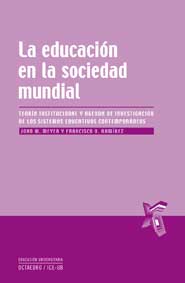
Sumario 1. Introducción: teorías institucionales de la educación en la sociedad mundial John Meyer y Francisco O. Ramirez (2009). "Introducción: teorías institucionales de la educación en la sociedad mundial". I. Desarrollos teóricos 2. Los efectos de la educación como institución John Meyer (1977). "The Effects of Education as an Institution". American Journal of Sociology. 3. Organizaciones institucionalizadas: la estructura formal con mito y ceremonia John Meyer y Brian Rowan (1978). "Institutionalized Organizations: Formal Structure as Myth and Ceremony". En M. Meyer et al., Environments and Organizations. 4. ¿De ciudadano a persona? La educación como incorporación Francisco Ramirez (2006). "From Citizen to Person? Rethinking Education as Incorporation". En David Baker y Alexander Wiseman (ed.). The Impact of Comparative Education Research on Neo-Institutional Theory. Oxford: Elsevier Science, pp. 367-388. II. Síntesis de la sociedad mundial 5. La institucionalización mundial de la educación John Meyer y Francisco Ramirez (2000). "The World Institutionalization of Education". En J. Schriewer (ed.), Discourse Formation in Comparative Education. Frankfurt: Peter Lang, pp. 111-132. 6. Currículos nacionales: modelos mundiales y tradiciones históricas nacionales Francisco Ramirez y John Meyer (2002). "National Curricula: World Models and National Historical Legacies". En M. Caruso y H. Tenorth (eds.), Internationalisation. Frankfurt: Peter Lang, pp. 91-107. 7. Derechos humanos y ciudadanía: la aparición de la educación en los derechos humanos David Suarez y Francisco Ramirez (2007). "Human Rights and Citizenship: The Emergence of Human Rights Education". En Carlos Alberto Torres, RD. Critique and Utopia: New Developments in the Sociology of Education. Lanham: Rowman and Littlefield Publishers, pp. 43-64. III. Definición de la agenda de investigación 8. Globalización, ciudadanía y educación: la eclosión de unos marcos de empoderamiento cosmopolitas, multiculturales e individuales Francisco Ramirez, John Meyer y Christine Wotipka (2008). "Globalization, Citizenship, and Education: The Rise and Spread of Cosmopolitan, Multicultural, and Individual Empowerment Frames". 9. La universidad en Europa y en el mundo: expansión en el siglo XX John Meyer y Evan Schofer (2006). "The University in Global Society: Twentieth Century Expansion". Publicado en alemán, español e ingles. 10. La expansión universitaria y la sociedad del conocimiento David Frank y John Meyer (2007). "University expansion and the knowledge society". Theory & Society. Bibliografía La educación, tanto la universal como la superior, representa una institución mo-derna imprescindible en toda sociedad contemporánea. Su condición de institución cultural cargada de significados esenciales sobre la naturaleza, la sociedad y la persona le confiere un enorme poder a la hora de elaborar los mitos institucionales racionalizados que permean la actual sociedad mundial, marcada por una globali-zación fulgurante y un debilitamiento tan rápido como el de la soberanía estatal, donde las sociedades locales ganan en estabilidad y legitimidad recurriendo a mo-delos internacionales de meritocracia. Por su parte, la universidad ha sobrevivido y triunfado en el mundo de hoy no por el hecho de forjar personas y culturas dentro de la gran máquina social moderna, sino más bien porque ha confeccionado los cimientos de una unidad cultural uni-versalista y fundamentada en principios que reformula en términos globales y uni-versales las particularidades locales tanto del conocimiento como de los conocedo-res. Este libro recoge una selección de los mejores trabajos relacionados con la educa-ción del «programa de investigación» sobre la world society de la llamada Escuela de Stanford, que abanderan sus autores, basado en un innovadora teoría neoinsti-tucionalista, con sólidos fundamentos empíricos y constituida por un conjunto co-nectado de ideas en torno a unas premisas comunes que intentan explicar diferen-tes aspectos de la realidad social y educativa de los sistemas educativos contempo-ráneos. El argumento institucional apunta, en definitiva, que la educación moderna crece y se expande por la transformación de las perspectivas políticas, religiosas y culturales de la sociedad y no por los requisitos técnicos de las funciones moder-nas: la educación está diseñada por la sociedad moderna ideal y no para la socie-dad local más inmediata ya que las sociedades modernas adoptan unas visiones culturales extraordinariamente parecidas de su progreso ideal y planificación.
EAN
9788499211220
Publisher
Edition year
2010
Pages
280
Binding
Soft cover or pocket
Language
Spanish
Collection
EDUCACION UNIVERSITARIA
Height
230
Width
150
24,80 €
-5%
23,56 €
24.80 €
- 5 % OFF
23.56 €