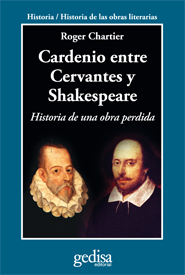
https://www.imosver.com/en/libros/cardenio-entre-cervantes-y-shakespeare-32303900023230390002CARDENIO ENTRE CERVANTES Y SHAKESPEARE23.65¿Cómo leer un texto que no existe, representar una obra cuyo manuscrito se perdió y de la que no se sabe con certeza quién fue su autor? Este es el enigma que plantea Cardenio -una obra representada ehttps://static.imosver.com/imagenes_small/9788497/978849784675.jpgLibrosLibros/NOVELASin stockGEDISA EDITORIAL000https://static.imosver.com/imagenes_small/9788497/978849784675.jpg001035291100103055920010509848MID000291824.951.252012/10/099788497846752CHARTIER, ROGERLibrosaño_2012idioma_SpanishCformato_Tapa blanda o Bolsilloautor_CHARTIER, ROGERsaga_S/C
Artículo
CARDENIO ENTRE CERVANTES
CHARTIER ROGER
GEDISA EDITORIAL
NOVELA
Cookie notice
We use cookies to ensure you get the best experience on our site
Read cookie policy.
Manage cookie preferences
This type of cookie allows the user to browse a website, platform, or application and to use the different options or services that exist on it.
imosver_session
Description
Essential first-party cookie. It keeps your session identified while you browse: your basket, your language and access to your account. The website cannot work without it.
Duration
120 minutes
Facilities
Domain
imosver.com
OCT8NE
Description
This cookie is used for the proper functioning of the Oct8ne Chat to provide customer support service to the user.
These are those that enable the tracking and analysis of user behavior on our website. The information collected is used to measure user activity on the website and to create user browsing profiles.
_clsk
Description
Microsoft Clarity first-party cookie. It groups the pages you visit into a single session in order to analyse your journey through the website.
Duration
1 days
Facilities
Domain
imosver.com
logglytrackingsession
Description
Identifies and records the user session for analytical purposes.
Duration
Session
Facilities
Domain
.imosver.com
GOOGLE_ANALYTICS
Description
Records a unique identifier that is used to generate statistical data about how the visitor uses the website.
Duration
1 Year
Facilities
Domain
.imosver.com
_clck
Description
Microsoft Clarity first-party cookie. It stores an anonymous browser identifier so that visits to this website can be attributed to the same user and usage statistics can be produced.
Duration
1 Year
Facilities
Domain
imosver.com
CLID
Description
Microsoft Clarity third-party cookie. It identifies the first time Clarity detects this browser on any website using the service.
Duration
1 Year
Facilities
Domain
clarity.ms
_ga
Description
Google Analytics cookie. It stores an anonymous browser identifier in order to distinguish users and produce website usage statistics.
Duration
2 Year
Facilities
Domain
.imosver.com
_ga_LZR660YW0M
Description
Google Analytics 4 cookie. It keeps the analytics session state so that visits and the journey through the website can be measured.
Duration
2 Year
Facilities
Domain
.imosver.com
These are the ones that allow us to adapt the navigation on our website to your preferences (e.g., language, browser used, etc.).
_fbp
Description
Used by Facebook to offer a series of advertising products, such as real-time bids from third-party advertisers.
Duration
3 Month
Facilities
Domain
.imosver.com
afiliado
Description
First-party affiliate programme cookie. It stores for 30 days the code of the affiliate that brought you to the website, so that the sale can be attributed to them.
Duration
1 Month
Facilities
Domain
imosver.com
MUID
Description
Microsoft third-party cookie. It identifies unique browsers visiting Microsoft sites and is used for advertising, analytics and other operational purposes.
Duration
1 Year
Facilities
Domain
clarity.ms
ANONCHK
Description
Microsoft third-party cookie. It indicates whether the MUID identifier is transferred to ANID, a cookie used for advertising purposes.
Duration
10 minutes
Facilities
Domain
clarity.ms
MR
Description
Microsoft third-party cookie. It indicates whether the MUID identifier must be refreshed.
Duration
7 days
Facilities
Domain
clarity.ms
SM
Description
Microsoft third-party cookie. It synchronises the MUID identifier across Microsoft domains.
Duration
Session
Facilities
Domain
clarity.ms
_fbc
Description
Meta cookie. It stores the identifier of the Facebook or Instagram advert you arrived from, in order to attribute the visit to that advertising campaign.
Duration
3 Month
Facilities
Domain
.imosver.com
_gcl_au
Description
Google Ads cookie. It records a visit coming from an advert so that advertising campaign conversions can be measured.
Duration
3 Month
Facilities
Domain
.imosver.com
_uetsid
Description
Microsoft Advertising cookie. It identifies your browsing session in order to measure conversions from Bing advertising campaigns.
Duration
1 days
Facilities
Domain
.imosver.com
_uetvid
Description
Microsoft Advertising cookie. It identifies your browser across visits in order to measure conversions from Bing advertising campaigns.
¿Cómo leer un texto que no existe, representar una obra cuyo manuscrito se perdió y de la que no se sabe con certeza quién fue su autor? Este es el enigma que plantea Cardenio -una obra representada en Inglaterra por primera vez en 1612 o 1613 y atribuida, cuarenta años más tarde, a Shakespeare (y Fletcher)-. Tiene como trama una "novela" inserta en Don Quijote, obra que circuló en los grandes países europeos, donde fue traducida y adaptada para el teatro; en Inglaterra, la novela de Cervantes era conocida y citada aun antes de ser traducida en 1612 y de inspirar Cardenio. Pero este enigma tiene otros desafíos. Era un tiempo en el que, principalmente gra-cias a la invención de la imprenta, los discursos proliferaban; el temor de su exceso a menudo conducía a enrarecerlos. No todos los escritos tenían la vocación de subsistir y, en particular, las obras de teatro que, muy a menudo, no eran impresas (el género, situado en lo más bajo de la jerarquía literaria, se adaptaba muy bien a la existencia efímera de las obras). Sin embargo, cuando un autor se había vuelto famoso, la búsqueda del archivo inspiraba la invención de reliquias textuales, la restauración de restos estropeados por el tiempo, la corrección, además, de faltas y, a veces, la fabricación de falsificaciones. Fue lo que sucedió con Cardenio en el siglo XVIII. Volver a delinear la historia de esta obra conduce, entonces, a interrogarse sobre lo que fue, en el pasado, el estatuto de las obras hoy juzgadas canónicas. El lector redescubrirá aquí la maleabilidad de los textos, transformados por su traducciones y sus adaptaciones; sus migraciones de un género al otro; las significaciones sucesivas que construyeron sus diferentes públicos. Para muchos de sus lectores, Don Quijote fue, durante mucho tiempo, un repertorio de "novelas", buenas para publicar por separado o para llevar a la escena, a costa de la coherencia de las aventuras del héroe epónimo, y Shakespeare, un dramaturgo que, de acuerdo con el modelo de muchos de sus colegas, escribía en colaboración, reciclaba historias de otros escritores, algunas de cuyas obras no encontraron editor. Así, gracias a Roger Chartier, se explica el misterio de una obra sin texto pero no sin autor.Introducción. Leer un texto que no existe / I. Cardenio en la corte. Londres, 1613 / II. Cardenio y don Quijote. España, 1605-1608 / III. Cardenio francés. París, 1628 y 1638 / IV. Cardenio en la Revolución. Londres, 1653 / V. Cardenio reencontrado. Londres, 1727 / VI. Cardenio representado. Inglaterra, 1660-1727 / VII. Cardenio sobre la escena. Londres, 1727 / Epílogo. La fiebre Cardenio