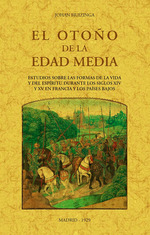
https://www.imosver.com/en/articulo/LMA0025923LMA0025923El otoño de la Edad Media18.05Considerada la principal obra del historiador holandés Johan Huizinga, fue traducida y editada por primera vez en España en 1929 por la afamada Revista de Occidente, fundada por Ortega y Gasset. Su https://static.serlogal.com/imagenes_small/9788490/978849001773.jpgLibrosLibros/HISTORIAEn stockMAXTOR000https://static.serlogal.com/imagenes_small/9788490/978849001773.jpgCIM0050638001050871500103294891950.952023/05/019788490017739Librosaño_2023idioma_SpanishCformato_Tapa blanda o Bolsilloautor_Huizinga, Johansaga_Clásicos Facsímil
Artículo
El otoño de la Edad Media
Huizinga Johan
MAXTOR
HISTORIA
Cookie Notice
We use cookies to ensure you get the best experience on our website.
Read cookie policy.
Gestionar preferencias de cookies
This type of cookie allows the user to browse a website, platform, or application and to use the different options or services that exist on it.
imosverlaravel_session
Description
This cookie is necessary for the website to function and cannot be disabled in our systems.
Duration
Sesión
Dependencies
Domain
imosver.com
OCT8NE
Description
This cookie is used for the proper functioning of the Oct8ne Chat to provide customer support service to the user.
These are those that enable the tracking and analysis of user behavior on our website. The information collected is used to measure user activity on the website and to create user browsing profiles.
_clsk
Description
It records statistical data about the visitor's behavior on the website. This is used for internal analysis by the website operator.
Duration
1 year
Dependencies
_clsk,MUID,_clck
Domain
logglytrackingsession
Description
Identifies and records the user session for analytical purposes.
Duration
Sesión
Dependencies
Domain
.imosver.com
GOOGLE_ANALYTICS
Description
Records a unique identifier that is used to generate statistical data about how the visitor uses the website.
Duration
1 year
Dependencies
Domain
.imosver.com
These are the ones that allow us to adapt the navigation on our website to your preferences (e.g., language, browser used, etc.).
_fbp
Description
Used by Facebook to offer a series of advertising products, such as real-time bids from third-party advertisers.
Considerada la principal obra del historiador holandés Johan Huizinga, fue traducida y editada por primera vez en España en 1929 por la afamada Revista de Occidente, fundada por Ortega y Gasset. Su redacción fue motivada por la necesidad de ofrecer una mejor comprensión del Renacimiento, asumiendo como evidente que los siglos bajomedievales en el Ducado de Borgoña (Francia y Países Bajos) son los apropiados para comprender las últimas formas de la cultura medieval (que entiende en decadencia) y el origen de la cultura moderna. Entre estas formas culturales se incluye: el ideal caballeresco, la concepción jerárquica de la sociedad, la estilización del amor, la imagen de la muerte, los tipos de religiosidad, el arte y la vida, la sensibilidad estética o el espíritu religioso y la expresión plástica. En conjunto, nos plantea la imagen de autoconcepción idealizada de la sociedad, elemento fundamental en la Historia de las Mentalidades planteada por Marc Bloch y Lucien Febvre desde la Escuela de los Annales, y que caracteriza a Huizinga como pionero en esta línea historiográfica que gozó de gran fama a partir de los años sesenta.