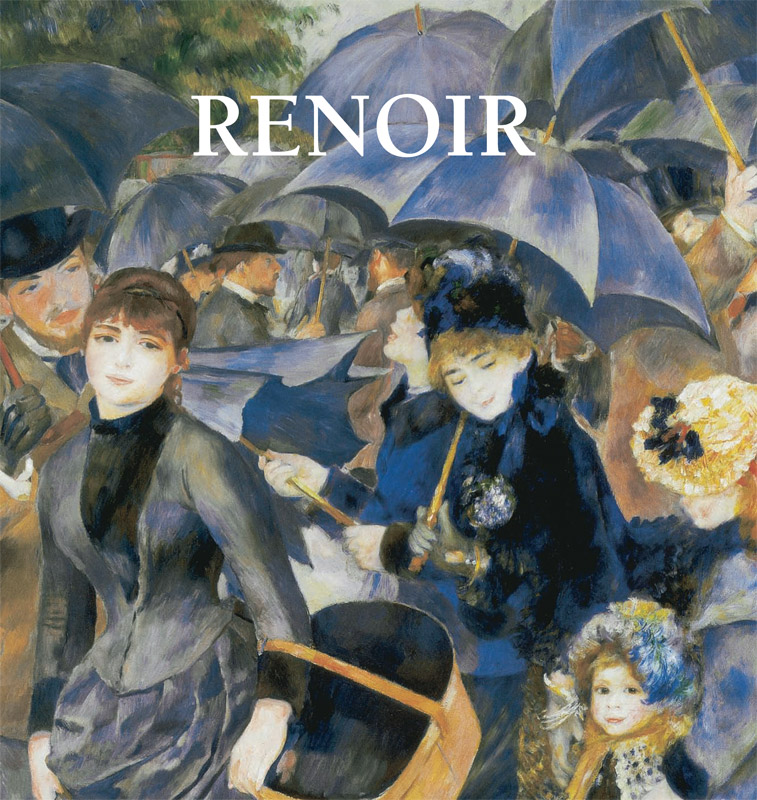
Sinopse RENOIR
Pierre-Auguste Renoir was born in Limoges on 25 February 1841. In 1854, the boy’s parents took him from school and found a place for him in the Lévy brothers’ workshop, where he was to learn to paint porcelain. Renoir’s younger brother Edmond had this to say this about the move: “From what he drew in charcoal on the walls, they concluded that he had the ability for an artist’s profession. That was how our parents came to put him to learn the trade of porcelain painter.” One of the Lévys’ workers, Emile Laporte, painted in oils in his spare time. He suggested Renoir makes use of his canvases and paints. This offer resulted in the appearance of the first painting by the future impressionist. In 1862 Renoir passed the examinations and entered the Ecole des Beaux-Arts and, simultaneously, one of the independent studios, where instruction was given by Charles Gleyre, a professor at the Ecole des Beaux-Arts. The second, perhaps even the first, great event of this period in Renoir’s life was his meeting, in Gleyre’s studio, with those who were to become his best friends for the rest of his days and who shared his ideas about art. Much later, when he was already a mature artist, Renoir had the opportunity to see works by Rembrandt in Holland, Velázquez, Goya and El Greco in Spain, and Raphael in Italy. However, Renoir lived and breathed ideas of a new kind of art. He always found his inspirations in the Louvre. “For me, in the Gleyre era, the Louvre was Delacroix,” he confessed to Jean. For Renoir, the First Impressionist Exhibition was the moment his vision of art and the artist was affirmed. This period in Renoir’s life was marked by one further significant event. In 1873 he moved to Montmartre, to the house at 35 Rue Saint-Georges, where he lived until 1884. Renoir remained loyal to Montmartre for the rest of his life. Here he found his “plein-air” subjects, his models and even his family. It was in the 1870s that Renoir acquired the friends who would stay with him for the remainder of his days. One of them was the art-dealer Paul Durand-Ruel, who began to buy his paintings in 1872. In summer, Renoir continued to paint a great deal outdoors together with Monet. He would travel out to Argenteuil, where Monet rented a house for his family. Edouard Manet sometimes worked with them too. In 1877, at the Third Impressionist Exhibition, Renoir presented a panorama of over twenty paintings. They included landscapes created in Paris, on the Seine, outside the city and in Claude Monet’s garden; studies of women’s heads and bouquets of flowers; portraits of Sisley, the actress Jeanne Samary, the writer Alphonse Daudet and the politician Spuller; and also The Swing and The Ball at the Moulin de la Galette. Finally, in the 1880s Renoir hit a “winning streak”. He was commissioned by rich financiers, the owner of the Grands Magasins du Louvre and Senator Goujon. His paintings were exhibited in London and Brussels, as well as at the Seventh International Exhibition held at Georges Petit’s in Paris in 1886. In a letter to Durand-Ruel, then in New York, Renoir wrote: “The Petit exhibition has opened and is not doing badly, so they say. After all, it’s so hard to judge about yourself. I think I have managed to take a step forward towards public respect. A small step, but even that is something.”
EAN
9781781605936
Editorial
Formato de ebook
EPUB
Ano de edición
2013
Páxinas
99
Dereitos de ebook
Número de activaciones: 6